Laser Cutting and Engraving Leather summary
Laser cutting and engraving leather is a highly popular technique in the fashion, crafting, and upholstery industries. It allows for the creation of intricate patterns, precise cuts, and permanent custom markings on various types of leather, offering a level of detail that is nearly impossible to achieve with manual tools.
How It Works
The process utilizes a focused laser beam to interact with the leather’s surface.
Laser Cutting: The laser beam completely vaporizes the material along a specific path to cut out shapes. One of the distinct features of laser cutting leather is that the heat effectively seals the edges, preventing the material from fraying.
Laser Engraving: The laser burns away only the top layer of the leather to create a depressed image or text. This often results in a debossed look with a darkened contrast, giving the leather a rustic or branded appearance.
Suitable Types of Leather
Not all leathers react the same way to laser processing. It is crucial to choose the right type to ensure safety and quality.
Leather Type
Description
Laser Suitability
Vegetable-Tanned Leather
Tanned using natural materials like bark.
Excellent. It cuts cleanly and engraves with a rich, dark brown contrast. It is the preferred choice for high-quality engraving.
Chrome-Tanned Leather
The most common type of soft leather (often used in clothing).
Good, but caution required. It can cut well but may produce more smoke and debris. Engraving results vary in contrast depending on the dye used.
Synthetic Leather (PU/Alcantara)
Artificial leather made from polyurethane or polyester.
Good. Many are laser-safe and offer consistent results, though they may not produce the same “burnt” contrast as natural leather.
Vinyl / PVC Faux Leather
Artificial leather made with Polyvinyl Chloride.
⚠️ DANGEROUS / DO NOT USE. Cutting PVC releases chlorine gas, which is toxic to humans and corrosive to the laser machine.
Advantages
Laser processing leather offers distinct benefits over traditional stamping or manual cutting:
Sealed Edges: The thermal nature of the laser cauterizes the cuts, eliminating the need for post-processing to stop fraying.
Contactless Processing: Since the leather doesn’t need to be clamped down tightly or subjected to the drag of a blade, there is no warping or stretching of the material.
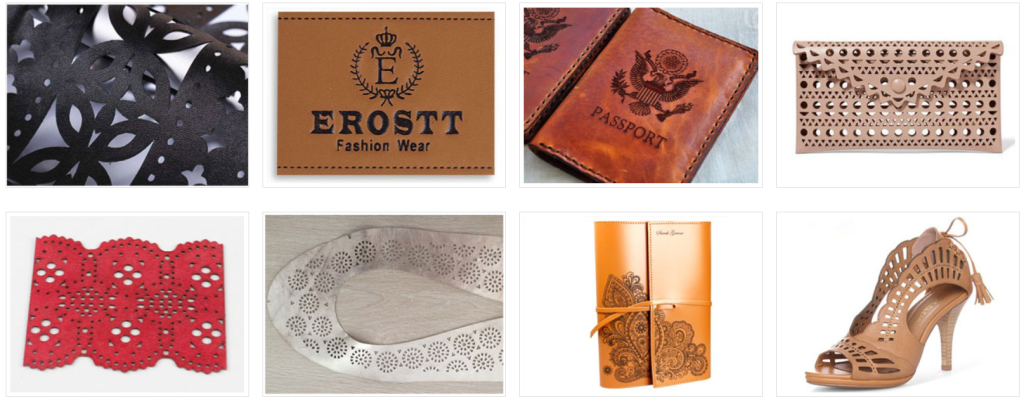
Intricate Detail: Lasers can cut complex lace-like patterns or engrave photo-realistic images that would be impossible with physical dies.
Durability: Engraved marks are permanent; they do not rub off like paints or inks.
Speed: Ideal for rapid prototyping and short-run production without the cost of creating physical molds or dies.
Applications
The versatility of laser-processed leather makes it a staple in several creative fields:
Fashion & Accessories: Custom wallets, belts, purses, and intricate leather jewelry.
Footwear: Cutting precise patterns for shoe uppers or engraving logos on insoles.
Labels & Patches: Creating durable branding patches for denim, hats, and bags.
Interior Design: Engraving custom patterns on leather upholstery or wall panels.
Personalization: Adding monograms or dedications to leather gifts.
How It Works
The process utilizes a focused laser beam to interact with the leather’s surface.
Laser Cutting: The laser beam completely vaporizes the material along a specific path to cut out shapes. One of the distinct features of laser cutting leather is that the heat effectively seals the edges, preventing the material from fraying.
Laser Engraving: The laser burns away only the top layer of the leather to create a depressed image or text. This often results in a debossed look with a darkened contrast, giving the leather a rustic or branded appearance.
Suitable Types of Leather
Not all leathers react the same way to laser processing. It is crucial to choose the right type to ensure safety and quality.
Leather Type
Description
Laser Suitability
Vegetable-Tanned Leather
Tanned using natural materials like bark.
Excellent. It cuts cleanly and engraves with a rich, dark brown contrast. It is the preferred choice for high-quality engraving.
Chrome-Tanned Leather
The most common type of soft leather (often used in clothing).
Good, but caution required. It can cut well but may produce more smoke and debris. Engraving results vary in contrast depending on the dye used.
Synthetic Leather (PU/Alcantara)
Artificial leather made from polyurethane or polyester.
Good. Many are laser-safe and offer consistent results, though they may not produce the same “burnt” contrast as natural leather.
Vinyl / PVC Faux Leather
Artificial leather made with Polyvinyl Chloride.
⚠️ DANGEROUS / DO NOT USE. Cutting PVC releases chlorine gas, which is toxic to humans and corrosive to the laser machine.
Advantages
Laser processing leather offers distinct benefits over traditional stamping or manual cutting:
Sealed Edges: The thermal nature of the laser cauterizes the cuts, eliminating the need for post-processing to stop fraying.
Contactless Processing: Since the leather doesn’t need to be clamped down tightly or subjected to the drag of a blade, there is no warping or stretching of the material.
Intricate Detail: Lasers can cut complex lace-like patterns or engrave photo-realistic images that would be impossible with physical dies.
Durability: Engraved marks are permanent; they do not rub off like paints or inks.
Speed: Ideal for rapid prototyping and short-run production without the cost of creating physical molds or dies.
Applications
The versatility of laser-processed leather makes it a staple in several creative fields:
Fashion & Accessories: Custom wallets, belts, purses, and intricate leather jewelry.
Footwear: Cutting precise patterns for shoe uppers or engraving logos on insoles.
Labels & Patches: Creating durable branding patches for denim, hats, and bags.
Interior Design: Engraving custom patterns on leather upholstery or wall panels.
Personalization: Adding monograms or dedications to leather gifts.
SAMPLES