
Laser welding, as a new, energy-saving, and environmentally friendly welding technology, is being increasingly applied to the manufacturing of automobile bodies and components. Recently, Pentium Laser has developed a precision laser welding machine specifically for the manufacturing of pipelines in automobile air conditioning systems, which is used for welding air conditioning pipelines and valve seats. The successful development of this equipment marks an important step towards the complete substitution of imported equipment with domestically produced laser welding equipment.
Precision laser welding is becoming the standard in the manufacturing of automotive air conditioning (A/C) tubing and heat exchange systems. As the industry shifts toward lightweight thin-walled aluminum alloys, the demand for precise stress control, airtightness, and automation has made traditional welding methods less viable.
Here is a breakdown of the core applications and technical advantages of using precision laser welding machines for automotive A/C pipelines.
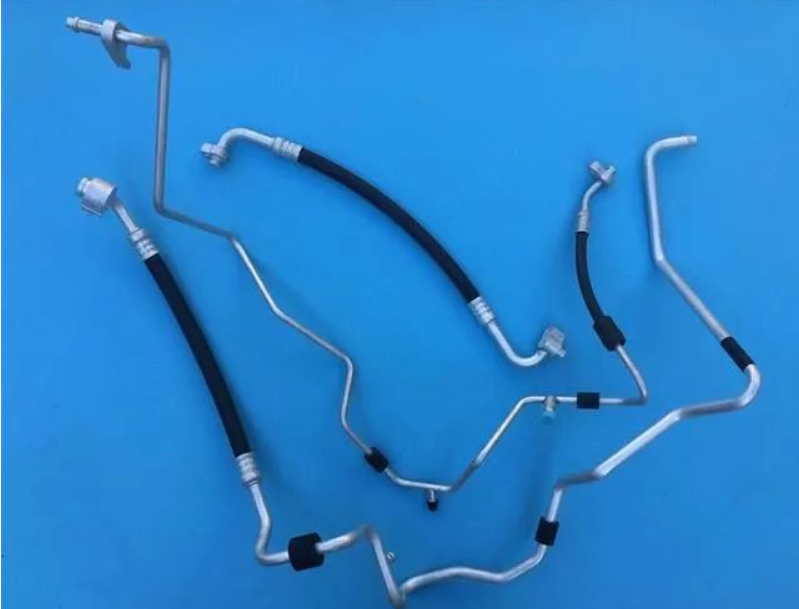
1. Core Application Scenarios
A. Aluminum Tubing to Flange (Connector) Welding
This is the most common application. A/C tubes must be connected to flanges to attach to compressors or condensers.
- The Challenge: Aluminum has high thermal conductivity and reflectivity, and the tube walls are very thin (0.8mm – 1.5mm). Traditional TIG welding or brazing often burns through the tube or deforms the flange.
- The Laser Solution: Laser welding provides concentrated energy to complete the melt and solidification process in milliseconds. It creates a deep, strong weld without overheating the surrounding area.
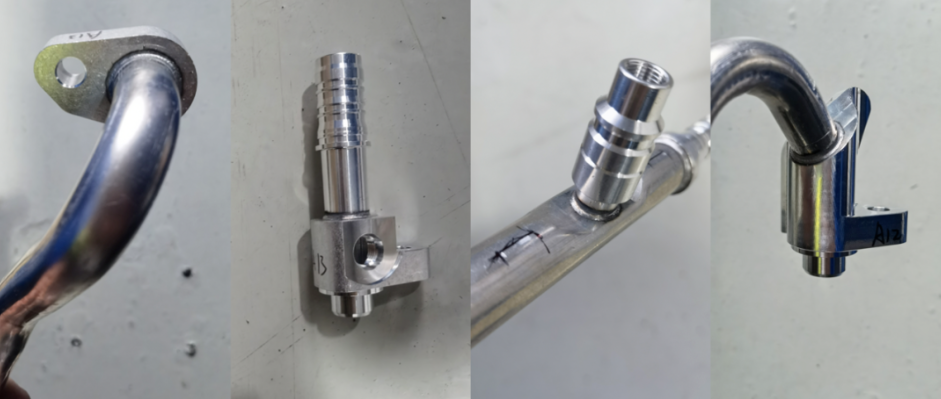
B. Micro-channel Flat Tube Welding
Modern condensers and evaporators use parallel-flow micro-channel designs.
- The Application: Sealing the connection between the collection header and the flat tubes.
- Why Laser: Because the walls of flat tubes are incredibly thin (<0.5mm), laser welding is one of the few technologies capable of ensuring high yields in mass production without damaging the delicate structure.
C. Sensor and Valve Connections
A/C systems contain pressure sensors and thermal expansion valves that contain sensitive electronics or rubber seals.
- The Application: Lasers can weld these components onto the pipeline with such localized heat that the internal electronics or rubber O-rings are not damaged by thermal transfer.
D. Dissimilar Metal Joining (Copper-Aluminum)
While less common now, some systems still require joining copper pipes to aluminum.
- The Application: Precision lasers, often using specific wobble patterns, can join these materials while minimizing the formation of brittle intermetallic compounds that usually cause cracks.
2. Technical Advantages over Traditional Methods
Compared to Flame Brazing or TIG Welding, precision laser welding offers significant benefits for A/C systems:
| Feature | Traditional Method Issues | Laser Welding Advantage |
|---|---|---|
| Heat Input | High heat spreads widely, softening the aluminum (annealing) and warping the pipe. | Minimal Heat Affected Zone (HAZ). The weld is narrow, and the pipe retains its original hardness and shape. |
| Airtightness | Prone to porosity (tiny bubbles), leading to refrigerant (R134a/R1234yf) leaks. | Produces a dense, non-porous weld structure capable of withstanding the high pressures of the A/C system. |
| Cleanliness | Brazing requires flux, which leaves corrosive residue that must be washed off. | Contact-free process. No flux, no slag, and no risk of contaminating the compressor with debris. |
| Consumables | Requires expensive brazing rings or filler wire. | Usually performs autogenous welding (self-fusion without filler), reducing material costs. |
3. Key Technologies for A/C Pipeline Welding
To handle the difficulties of welding circular aluminum tubes, specific laser technologies are used:
- Wobble Welding (Beam Oscillation):
Instead of moving in a straight line, the laser beam creates a tiny spiral or “figure-8” pattern. This widens the weld seam, allowing the machine to bridge small gaps between the tube and flange (improving fit-up tolerance) and helping gas bubbles escape to prevent porosity. - Visual Seam Tracking:
Since bent A/C tubes often have slight shape variations, a vision system tracks the joint in real-time, adjusting the laser focus to ensure the beam always hits the exact center of the seam. - Rotary Welding Workstations:
Specialized fixtures clamp the tube and rotate it 360 degrees under the laser head (or rotate the optics) to ensure a seamless circumferential weld.
Summary
In the automotive A/C sector, precision laser welding ensures zero-leakage performance. It replaces the “dirty” and inconsistent process of brazing with a clean, high-speed, and fully automated solution that protects the integrity of thin-wall aluminum components.