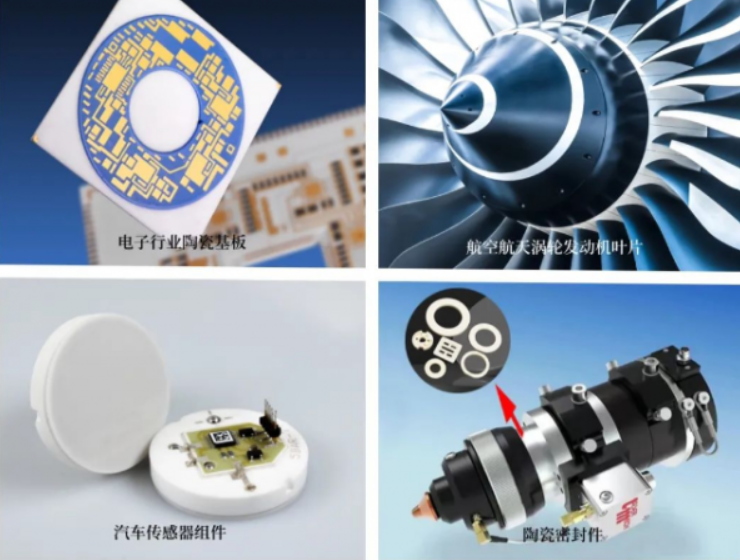
Precision manufacturing often relies on the CO2 laser cutting of alumina ceramics to produce high-density substrates for the electronics and aerospace industries. Because alumina ($Al_2O_3$) is both incredibly hard and thermally resistant, traditional mechanical sawing often leads to tool wear and chipping.
The laser provides a non-contact solution, but it requires a delicate balance of physics and finesse.
1. The Science of Absorption
When optimizing the CO2 laser cutting of alumina ceramics, understanding the $10.6\ \mu m$ wavelength interaction is critical. Alumina is nearly “black” to this specific wavelength, meaning it absorbs the energy almost perfectly.
This high absorption rate allows the laser to rapidly heat the ceramic to its melting point (approx. 2,072°C). However, because ceramics are poor thermal conductors, that heat stays concentrated in a very small area, creating a massive temperature difference between the “cut zone” and the rest of the board.
2. Managing Thermal Stress
The primary hurdle in the CO2 laser cutting of alumina ceramics is managing the extreme thermal gradients that lead to micro-cracking. If the material heats up too fast or stays hot for too long, the internal tension will cause the ceramic to shatter like a glass plate in a microwave.
To combat this, operators use short, high-peak-power pulses. This “vaporizes” the material in tiny bursts, giving the surrounding ceramic a millisecond to breathe and dissipate heat before the next hit.
3. Optimization and Gas Assist
Using pulsed mode rather than a continuous wave is a “cheat code” for successful CO2 laser cutting of alumina ceramics. Furthermore, the choice of assist gas—usually high-pressure nitrogen or compressed air—is vital for blowing away the “dross” (the melted ceramic slag) before it can re-solidify and fuse the cut shut.
- Nitrogen: Best for preventing oxidation and maintaining a clean, white edge.
- Oxygen: Can increase cutting speed but may leave a glassy, yellowish finish.
4. Summary of Benefits
Despite the brittleness of the material, the CO2 laser cutting of alumina ceramics remains the most cost-effective method for high-volume production. It allows for:
- Intricate geometries (circles, slots, and tabs) that a diamond saw can’t touch.
- Extreme repeatability for PCB substrates.
- Reduced material waste due to a very narrow kerf (the width of the cut).
Note: For ceramics thicker than $2\ mm$, the risk of cracking increases exponentially. In these cases, “scribing and snapping” (cutting 30% deep and breaking manually) is often the safer professional choice.